
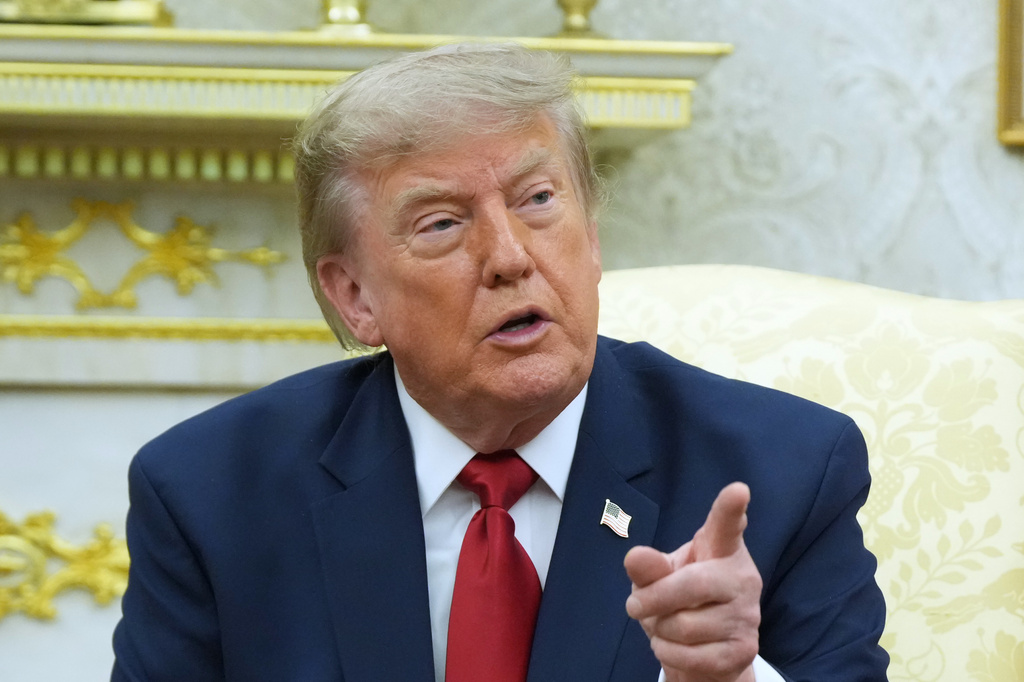
President Trump says the US is engaged in “very friendly negotiations” with Tehran, while also warning that large-scale operations against Iran could resume if no deal is reached.
By World Israel News Staff
President Donald Trump said Washington is engaged in “very friendly negotiations” with Iran, while warning that American military operations will resume if the talks fail to produce a rapid agreement.
Speaking Monday at a rally in Michigan, Trump portrayed the negotiations as the product of sustained US military pressure and said Iran could not be persuaded through financial incentives.
“You can’t bribe them. You’ve got to beat them, and we’ll beat the hell out of them,” Trump said. “But we’ll see how it turns out. Right now, there are very friendly negotiations going on.”
Trump said preventing Iran from obtaining a nuclear weapon remained the central objective of US policy.
“When somebody comes up and says, ‘Why are we doing this?’ just say, ‘Because we cannot let Iran have a nuclear weapon,’” he said. “It’s very simple. It’s all you have to say. There is nothing else you have to say.”
The president made the comments after the US suspended a nearly two-week bombing campaign against Iran, creating a temporary pause in the five-month conflict. Iran has also refrained from directly attacking US forces during the pause, although Iran-backed groups have continued operating elsewhere in the region.
Trump told reporters aboard Air Force One earlier Monday that Iran had sought renewed negotiations after sustaining extensive damage from American strikes.
“They want to meet, and we’re meeting. We’ll see what happens,” Trump said. “There’s a chance we can make a deal.”
“Without what we did, they wouldn’t even be talking to us,” he added. “They requested a meeting through their surrogates and directly, and we’re meeting.”
The president said the talks were progressing but made clear that the pause in military operations was conditional.
“We’re having good talks, so we’ll see what happens,” Trump said. “I think there’s a good chance something could happen. And if it does, good. If it doesn’t, we go back to doing what we were doing two days ago.”
In a separate interview with Axios, Trump described the negotiations as “very deep talks” and said Washington would return to “very strong military action” if diplomacy failed.
Asked how long he was prepared to allow the negotiations to continue, Trump replied: “Not much time. Either it goes fast or not at all.”
Trump said he agreed to pause planned attacks after countries mediating between Washington and Tehran asked him to give diplomacy another opportunity.
Iran, however, disputed Trump’s claim that Tehran had requested negotiations.
Iranian Foreign Ministry spokesman Esmail Baghaei said messages were continuing to pass through intermediaries but denied that direct US-Iran negotiations were taking place. He described reports that Iran had asked to reopen talks as “fabricated.”
“This is not in our DNA,” Baghaei said.
Baghaei acknowledged that mediators could deliver messages from Washington and said Iran had not abandoned diplomacy. Regional officials said Qatar and Pakistan were leading efforts to restore an interim ceasefire that collapsed during the latest exchange of attacks.
One regional official described the progress achieved by mediators as “significant.”
The immediate negotiations reportedly center on restoring maritime traffic through the Strait of Hormuz, the strategically important waterway through which a large share of the world’s oil supplies passes.
Iran maintains that it has the authority to supervise vessels using the strait and has proposed charging transit fees. The US has demanded unrestricted navigation and has supported an alternative shipping route closer to Oman’s coastline.
Baghaei said Iran and Oman were discussing ways to “develop mechanisms to ensure safe navigation through the Strait of Hormuz while respecting the sovereign rights and sovereignty of both coastal states, as well as Iran’s security and national interests.”
Despite the negotiations, Iranian state media reported Monday that Iran had turned back six vessels accused of attempting to enter the waterway without authorization. Commercial traffic through the strait remains severely reduced.
The US military has also maintained a naval blockade against Iran, reporting that commercial vessels have been redirected, disabled or boarded during the operation.
Regional violence continued during the pause in direct US-Iran attacks. Saudi Arabia said it intercepted drones launched by Iran-backed militias in Iraq toward petroleum facilities, including targets near Riyadh. Jordan also reported shooting down two drones, while Iran-backed Houthi forces in Yemen claimed an attack on Saudi oil infrastructure.
Trump dismissed suggestions that declining American munitions stocks had forced him to pause the bombing campaign. Reports indicated that senior military officials had warned that available targets were becoming limited and that extended operations could further strain inventories of missiles and other precision weapons.
The president said the US arsenal was “in very good shape,” although he acknowledged that he would prefer to possess more advanced munitions.
Trump’s comments came one day before a scheduled White House meeting with Israeli Prime Minister Benjamin Netanyahu, who said Iran would be the leading issue on the agenda.
Netanyahu said before departing for Washington that Israel’s goals were to protect its security and expand regional peace agreements.