
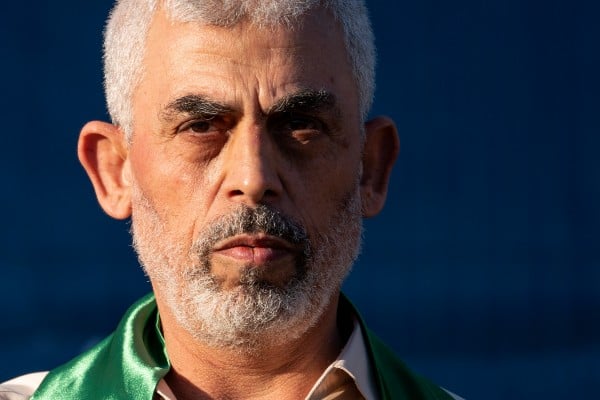
Captured documents reportedly show that Hamas chief Yahya Sinwar planned October 7 attacks to be part of a multi-front invasion of Israel, with incursions from Lebanon, Jordan, and Syria.
By World Israel News Staff
Captured Hamas documents analyzed by Israeli researchers indicate that Hamas chief Yahya Sinwar expected Hezbollah to open a major northern front during the October 7 attack, and that Hamas had discussed several wider-war scenarios with the Lebanese terror group in the years before the massacre.
The documents, reported Sunday by Galei Tzahal journalist Doron Kadosh and analyzed by the Meir Amit Intelligence and Terrorism Information Center, describe Sinwar’s efforts to draw Hezbollah into a multi-front war against Israel involving Gaza, Lebanon and additional fronts from Syria and Jordan.
According to the report, Sinwar did not propose only one plan to Hezbollah chief Hassan Nasrallah, but laid out several possible attack scenarios. Some envisioned broad cooperation by members of the Iranian-backed regional axis, while others involved more limited participation by Hezbollah and other actors.
A recurring element in the discussions was Sinwar’s interest in the Jordanian border as a major front.
The documents reportedly show that in June 2022, he promoted the idea of guerrilla forces entering Israel from both Syria and Jordan, believing that multiple simultaneous fronts would overwhelm Israel and divide its forces.
The correspondence suggested that Nasrallah received the proposals positively.
According to the reported documents, the Hezbollah leader called one of the plans a “realistic scenario that can be realized” and said he would raise it with Iranian Supreme Leader Ali Khamenei for approval.
The report said the scenarios discussed between Hamas and Hezbollah did not call for direct Iranian participation in the fighting. Instead, Iran was expected to remain outside the battlefield while Hamas, Hezbollah and other members of the axis carried out the campaign.
Sinwar’s confidence reportedly grew through a series of meetings and exchanges. In June 2023, he told Hamas’s political bureau in Gaza that the group had succeeded in shifting the posture of Hezbollah and Iran.
“In recent months, we have succeeded in bringing Hezbollah and the Iranians out of their ‘psychological deterrence’ mindset that has existed since 2006 in the Dahieh. Now the Iranians and Hezbollah are prepared,” Sinwar said, according to the documents.
Roughly six weeks before the attack, Sinwar addressed Hamas’s Shura Council and again expressed confidence that a major operation would trigger a regional response.
“We are certain that if the great strategic battle breaks out, God willing, many fronts will be opened against this enemy,” he said in August 2023, according to the report.
But Hamas’s own intelligence officials were reportedly less certain. An internal military intelligence assessment warned of a “psychological barrier” within Hezbollah and suggested the Lebanese group still had doubts about entering a full-scale war with Israel.
That warning did not appear to change Sinwar’s assessment. The documents indicate he remained convinced that Nasrallah would join the fighting once Hamas launched the assault.
At 6:29 a.m. on October 7, as Hamas began its attack on southern Israel, Sinwar reportedly sent Nasrallah a message apologizing for not giving advance notice of the timing and urging Hezbollah to join immediately.
“We ask for support and assistance,” Sinwar wrote, according to the documents. He later called on Hezbollah to “hurry and take part… in concentrated rocket bombardments… and begin a major ground offensive.”
The October 7 letter was first disclosed by Israeli journalist Ben Caspit in 2025. The document was reportedly written by Hamas leaders Mohammed Deif, Yahya Sinwar and Marwan Issa, addressed to Nasrallah and senior IRGC Quds Force official Saeed Izadi, and found in a bunker used by Sinwar and Hamas’s military leadership.
In that letter, the Hamas leaders described the opening attack and urged Nasrallah to act. “Today, Al-Aqsa and its defenders are calling on you, and so are the martyrs in Gaza, Syria, and Lebanon,” they wrote, according to the Jerusalem Post. The letter also declared: “This campaign will change the rules of the game.”
Hezbollah did not launch the major ground offensive Sinwar had apparently expected.
Hezbollah terrorists and Israeli soldiers exchanged fire on October 8, one day after the Hamas-led massacre, but the group initially limited its attacks to the border area rather than opening a full northern invasion.
The gap between Sinwar’s expectations and Hezbollah’s actual response is one of the central findings of the new analysis. The report argues that Sinwar believed the attack would almost automatically ignite additional fronts, but that Hezbollah hesitated and joined only in a limited fashion.