
Experts now describe Iran’s enrichment capability as “severely degraded” but not eliminated.
by Ailin Vilches Arguello, The Algemeiner
As the US seeks a deal to prevent the Iranian regime from building nuclear weapons, a new satellite imagery assessment finds no evidence of active uranium enrichment in Iran, though experts warn the country’s nuclear program remains damaged but not fully dismantled.
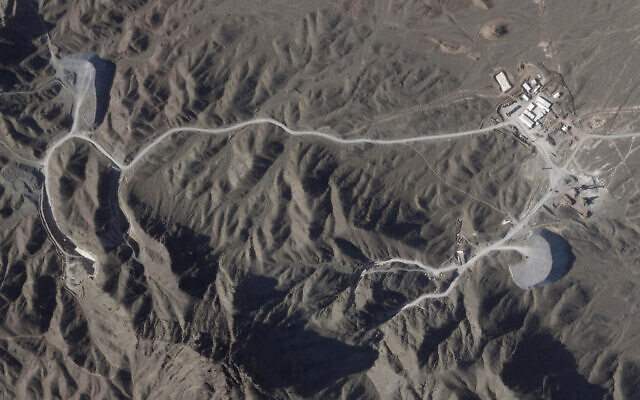
According to a new report published by the Institute for Science and International Security (ISIS), a Washington, DC–based think tank, major enrichment-related sites in Iran show no signs of ongoing nuclear fuel production following the April ceasefire with the US.
Based on commercial satellite imagery of facilities at Natanz, Fordow, Esfahan, and other known nuclear-linked sites, the report notes that key centrifuge production infrastructure appears to have been destroyed or rendered inoperable.
Experts also point out there is no visible reconstruction at major above-ground sites that previously supported Iran’s enrichment program.
However, ISIS’s latest assessment cautions that this does not mean the program has been fully eliminated, but rather that significant parts of Iran’s nuclear infrastructure remain buried underground or partially inaccessible, limiting visibility into its true condition.
In particular, the analysis highlights facilities at Natanz and Esfahan, both located in the country’s central region, where tunnel complexes and buried halls may still contain damaged but recoverable centrifuge equipment.
Experts also warn that significant uncertainty remains over stored enriched uranium, suggesting some material may still be held inside hardened facilities even if it is not currently being processed.
At Fordow, the report notes less visible damage compared to other sites, raising questions about what equipment may still be intact underground, though it emphasizes that there is no evidence of active enrichment taking place there or elsewhere.
“The existence of the enriched uranium or centrifuge-related items should not be confused with Iran’s ability to enrich uranium, a capability not now existing in Iran,” the report says.
Experts now describe Iran’s enrichment capability as “severely degraded” but not eliminated, saying the country’s nuclear program is fragmented, with some core components destroyed and others left intact but inactive.
According to the assessment, one of the main concerns is that remaining infrastructure could allow Iran to restart parts of the program if conditions change or if technical recovery becomes possible over time.
Still, the report emphasizes that no operational enrichment activity has been detected across any monitored sites since the ceasefire, with experts saying this represents a significant setback for Iran’s nuclear program, even if it is not a final one.
There is still no consensus on how long Iran’s reconstruction will take. Current estimates range from several months to several years, depending on the weapons system and the scale of foreign assistance Tehran is able to secure.
Israeli officials have pointed to Russian smuggling networks and Chinese support as important factors in Iran’s reconstruction efforts.
However, the scale of such transfers is reportedly more limited than before because of increased US maritime pressure and restrictions on large-scale shipments.