
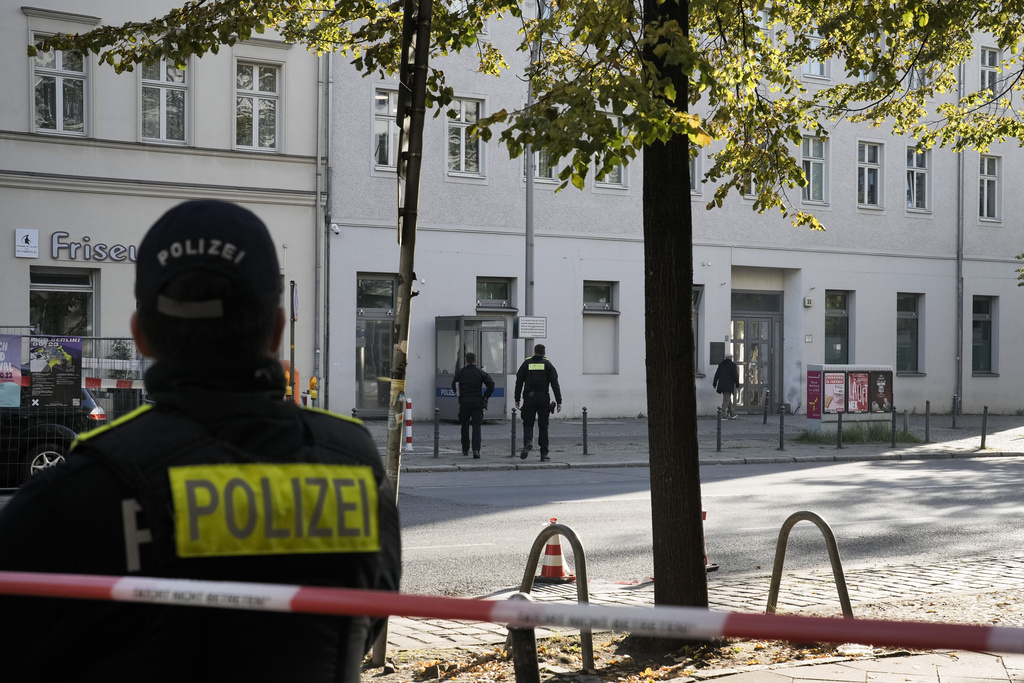
In the last few weeks alone, reports have emerged of a pastor being called a “Jewish pig,” Jewish students fearing violence in their schools, and security staff at Berlin Brandenburg Airport hurling antisemitic insults.
By Ailin Vilches Arguello, The Algemeine
The relentless wave of antisemitism sweeping Germany has created an increasingly hostile and dangerous reality as antisemitic incidents surge to unprecedented levels, turning fear, harassment, and exclusion into a routine part of everyday life.
According to new statistics published Tuesday by the German Federal Ministry of the Interior, the number of hate crimes in Germany climbed to a record 22,159 cases in 2025.
In particular, antisemitic offenses were among the fastest-rising categories, reaching an all-time high of 6,548 cases amid a volatile social climate targeting Jews and Israelis.
In the last near-decade, antisemitic hate crimes in Germany have surged dramatically, more than quadrupling from 1,504 recorded cases in 2017.
Among the reported incidents were threats, vandalism, social exclusion, physical assaults on individuals, and attacks on Jewish institutions, highlighting what Jewish leaders describe as an increasingly hostile environment across Germany.
“Incidents of this kind show that antisemitism has long been a part of everyday life – in schools, government offices, and political debates,” Andreas Büttner, the Brandenburg Commissioner against Antisemitism, said in a statement.
In the last few weeks alone, reports have emerged of a pastor being called a “Jewish pig,” Jewish students fearing violence in their schools, and security staff at Berlin Brandenburg Airport allegedly hurling antisemitic insults at two travelers bound for Tel Aviv.
German media reported this week that, after two years in office, Büttner warned of a “creeping normalization” of antisemitism, saying anti-Jewish hostility had increasingly penetrated the mainstream of German society.
He also noted that official statistics likely understate the true extent of antisemitism, as many victims refrain from reporting incidents out of fear or skepticism that authorities will take effective action.
“Hatred of Jews has become louder, more open, and more commonplace, and the boundaries of what is socially acceptable to say have shifted,” Büttner said.
For example, he pointed to a recent case involving a former Brandenburg city councilor who allegedly declared that “a world without Jews would be a better world.”
In a recent incident, a group of customers was reportedly asked to leave a café at Berlin’s Potsdamer Platz — one of the capital’s busiest public squares — on Saturday after one member of the group displayed an Israeli flag.
According to the German newspaper Bild, the incident unfolded on the sidelines of a pro-Palestinian demonstration in Berlin-Mitte, where police reportedly had to shield the group after protesters began harassing them.
In social media videos widely circulated online, the group can be seen sitting in the cordoned-off outdoor area of the Espresso House café when an employee allegedly asked them to leave because one woman was wearing an Israeli flag draped over her shoulders.
After the incident drew widespread media attention and sparked outrage among Jewish leaders and political figures, the café chain’s managing director, Nikolas Niebuhr, said the group had been loudly chanting slogans as demonstrators passed by, which he said was the reason they were asked to leave.
“Guests felt disturbed and complained. We don’t want to be part of a demonstration. We simply want to sell coffee,” Niebuhr told the German newspaper Berliner Zeitung.
Reflecting broader concerns within Germany’s Jewish community, Babka & Krantz, a Jewish bakery owned by Polish and Israeli immigrants in Berlin, closed last week, with its owners pointing to both financial difficulties and antisemitic harassment.
Located in Berlin’s Friedenau district, café owners and married couple Shahar Elkin and Marcin Liera-Elkin opened their first shop in November 2022, later expanding in December 2024 with a second location near the memorial at the site where Nazi officials planned the Holocaust’s “Final Solution.”
However, the second location closed last November, and now the original bakery has also shut down, bringing the venture to an end.
“We are just a bakery that wants to offer great products. But now we are only confronted with problems and politics that leave us in despair,” Elkin told the German newspaper Morgenpost.
“We really don’t know if Berlin is still the right place for us.”