Some observers argue that Trump’s decision to extend the U.S.-Iran ceasefire reflects a fragile stalemate in which neither side wants to resume war, yet neither is ready to compromise.
By Mardo Soghom, Middle East Forum
Iran’s remaining military and civilian leadership took a victory lap after President Donald Trump extended a temporary ceasefire on April 21, 2026.
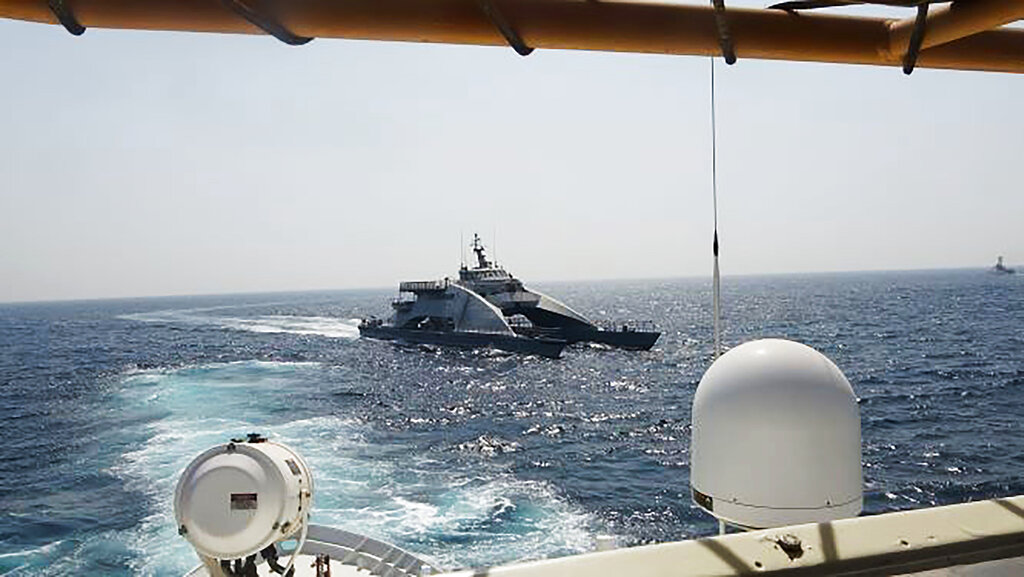
Senior figures brandished their ability to disrupt commercial navigation in the Strait of Hormuz, while also signaling a willingness to escalate pressure on Arab neighbors in the Persian Gulf—including by threatening their internet connectivity.
“In the forty-day war, Iran showed how, by defining the battlespace in the Persian Gulf and the Strait of Hormuz, it can turn its strategic advantage into leverage to reshape the course of the conflict,” announced Nour News, a website reflecting the views of Iran’s national security council.
In a separate commentary, the outlet wrote, “The few-hours shift by Donald Trump from threatening not to extend the ceasefire to announcing a unilateral ceasefire is a clear sign of a deadlock in Washington’s calculations.”
The IRGC created an AI slop video mocking Trump over their decision not to attend talks in Pakistan. pic.twitter.com/9dLbVodp7z
— Ariel Oseran أريئل أوسيران (@ariel_oseran) April 22, 2026
By conditioning its approach on lifting the naval blockade, Tehran has altered the dynamics of the standoff, Nour News claimed, and added that its warnings about the security of oil production signal a broader escalation—one that ties energy markets and regional stability more directly into the confrontation.
Tasnim, a media outlet close to the Islamic Revolutionary Guard Corps, highlighted the remarks of a regime propagandist who claimed the U.S. extension of the ceasefire was a “unilateral” act and emanated from the political deadlock Trump faces.
Tehran did not negotiate to extend the ceasefire, but Trump had no other choice, the report said.
Tasnim claimed that Iranian officials have not expressed their agreement with the ceasefire and have left their options open for challenging the U.S. naval blockade.
Tasnim also portrayed the Strait of Hormuz not only as a vital route for global energy flows but also as a critical bottleneck for the region’s digital infrastructure.
It emphasized that Gulf Arab states—including the United Arab Emirates, Qatar, Bahrain, Kuwait, Saudi Arabia, Iraq, and even parts of Iran—rely heavily on undersea internet cables that pass through this narrow corridor, underscoring its broader strategic significance.
Some observers argue that Trump’s decision to extend the U.S.-Iran ceasefire reflects a fragile stalemate in which neither side wants to resume war, yet neither is ready to compromise.
Both Washington and Tehran believe they hold leverage—Iran through its disruption of the Strait of Hormuz, and the U.S. through its overall military superiority.
The Trump administration and the president’s Republican allies face rising domestic political costs, while Iran is dealing with cumulative military and economic damage, even as it can shift much of that burden onto its population.
With both sides waiting for the other to concede and calculating that time may work in their favor, the result is a tense impasse: no return to conflict for now, but no meaningful progress toward a settlement, either.
Others see Iran as creating traps and using delaying tactics in the ceasefire period.
They argue that two weeks after Donald Trump announced a ceasefire linked to reopening the Strait of Hormuz, the situation has reversed into a cycle of escalation.
Iran initially conditioned reopening the Strait on a halt to Israeli attacks on Hezbollah but kept it closed even after that ceasefire was secured.
Washington responded with a naval blockade, arguing that Iran cannot restrict others’ transit while expecting freedom for its own shipping.
Tehran has since cited the blockade as a reason to refuse further talks—illustrating a pattern critics describe as creating a crisis, rejecting responsibility, and then objecting to the consequences.
The current trajectory suggests a deliberate shift by Trump away from immediate military escalation toward sustained economic pressure, with the naval blockade serving as a central tool to constrain Tehran.
Whether this reflects confidence that financial strangulation can achieve what force could not, or simply a pause before a potential next phase of conflict, remains unclear.
At the same time, Iran may be betting that U.S. political constraints and sensitivity to energy markets will limit Washington’s options, though signs of underlying strain within the system cannot be ruled out.
For now, both sides appear to be testing the limits of pressure and patience, with the risk that any miscalculation—particularly an attack on U.S. assets—could trigger a more severe response.