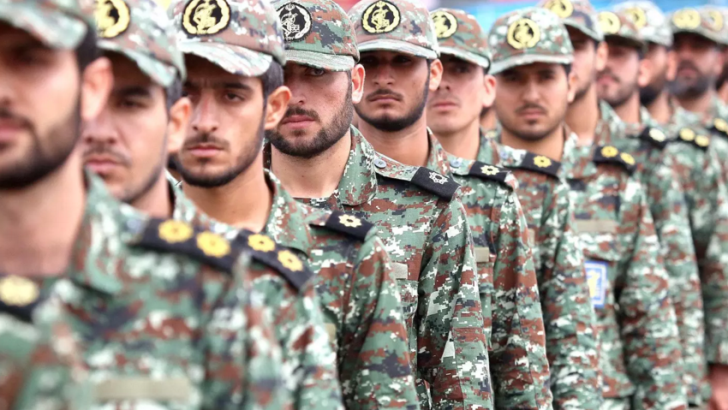
As long as the Islamic Revolutionary Guard Corps remains intact and its leadership unaccountable for the killing of thousands of Iranians and its regional activities, reformist figures are likely to continue falling in line.
By Mardo Soghom, Middle East Forum
Reports circulating in Iranian diaspora media and on social platforms suggest that President Masoud Pezeshkian has lost what little authority he had and is now operating under the tight control of current Islamic Revolutionary Guard Corps leaders.
While such claims appear plausible, Iranian presidents never have exercised power over matters of war and peace—particularly now, when there is no visible, functioning supreme authority at the apex of the system.
There has been no proof of life for Mojtaba Khamenei, who reportedly succeeded his father, Ali Khamenei, in early March 2026, in more than four weeks.
U.S. or Israeli air strikes have eliminated other influential figures, including former parliamentary speaker Ali Larijani and senior security figure Ali Shamkhani.
In such a vacuum, a near-total consolidation of power by the Islamic Revolutionary Guard Corps would be unsurprising.
In this context, Pezeshkian reportedly has continued to push for the restoration of executive and administrative authority to the government.
The effort has met resistance from Revolutionary Guard commander Ahmad Vahidi, who has attributed the economic crisis to the president’s failure to pursue structural reforms before the outbreak of hostilities; there are unconfirmed rumors that Vahidi died in a March 29, 2026, airstrike.
Pezeshkian also has warned that the country cannot withstand sustained economic pressure for more than two to three weeks, underscoring the urgency of a ceasefire.
He has called for a halt in attacks on neighboring countries, while also issuing threats of retaliation.
Although the late Supreme Leader Ali Khamenei enabled the Islamic Revolutionary Guard Corps’ rise as the dominant political force over the past two decades, he sought a façade of institutional balance between the presidency and the military.
Since around 2011, however, the regime has reduced presidents to technocratic administrators—tasked with managing a deteriorating economy while aligning themselves with the leadership’s strategic direction and only signaling muted concern about militarization.
In mid-2017, a newly re-elected and emboldened President Hassan Rouhani openly criticized the Islamic Revolutionary Guard Corps as “men with guns” wielding disproportionate influence over the economy and political life.
Within days, he was forced to reverse course, meet Revolutionary Guard leaders in the presence of Qods Force Chief Qasem Soleimani, and abandon any pretense of independent authority.
One anonymous post on X has alleged that Pezeshkian is suffering from severe psychological strain—unable to sleep, eat, or function coherently—and should be removed.
While such claims may be disinformation circulated by Revolutionary Guard-linked channels, there is little doubt that Pezeshkian—already seen as awkward and ineffective—faces pressure and has limited room to maneuver.
The Reformist Front, which had cautiously supported the president, has largely fallen silent on the need to resolve tensions with the United States and halt the war.
Individual figures have occasionally voiced support for “unity” and “resistance,” but avoided confronting the structural drivers of the crisis.
Major reformist politicians have criticized militarism and warned about economic decline yet have done little to alter the trajectory set by the regime’s hardline core.
During successive waves of nationwide protests, they either aligned themselves with Khamenei and the Islamic Revolutionary Guard Corps or withheld meaningful support from demonstrators.
Their political survival, economic interests, and institutional roles remain deeply intertwined with the system.
As a result, reformists have lost much of their remaining public credibility, reflected in sharply declining voter participation since 2020 and repeated nationwide protests—in 2017, 2019, 2022, and 2026—that have rejected both the ruling establishment and its reformist wing.
As long as the Islamic Revolutionary Guard Corps remains intact and its leadership unaccountable for the killing of thousands of Iranians and its regional activities, reformist figures are likely to continue falling in line.
U.S. and Israeli strikes on regime targets in Tehran intensified on March 28, as Revolutionary Guard-linked media emphasized their own attacks on targets in Saudi Arabia and the United Arab Emirates.
Iranian military officials continued to threaten a response to any U.S. ground incursion, while claiming to have reduced tanker traffic from the Persian Gulf by as much as 95 percent.
Meanwhile, Nima Monsefi, an Iranian analyst in Australia, urged residents of coastal areas to move at least fifty miles inland, anticipating possible U.S. military action to reopen the Strait of Hormuz.
He warned that civilians who remain could become human shields for the Revolutionary Guard in the event of escalation.