
According to the report, Globus Relief transferred at least $119 million and Lifting Hands nearly $20 million to about 10 such groups over several years.
By Shmuli Volkin, Jewish Breaking News
A new investigation is raising uncomfortable questions about how Western humanitarian money can end up circulating through Islamist networks tied to Hamas—sometimes through multiple layers of “partner” charities before reaching Gaza.
A report cited says two U.S.-based, Mormon-affiliated nonprofits—Globus Relief and Lifting Hands International—collectively routed tens of millions of dollars to overseas NGOs described as connected to Hamas-linked structures or officials.
The findings come from the Middle East Forum and rely on publicly available U.S. nonprofit filings and grant disclosures, focusing on what it calls a pattern of repeated large transfers to a cluster of organizations it labels “radical Islamist” charities.
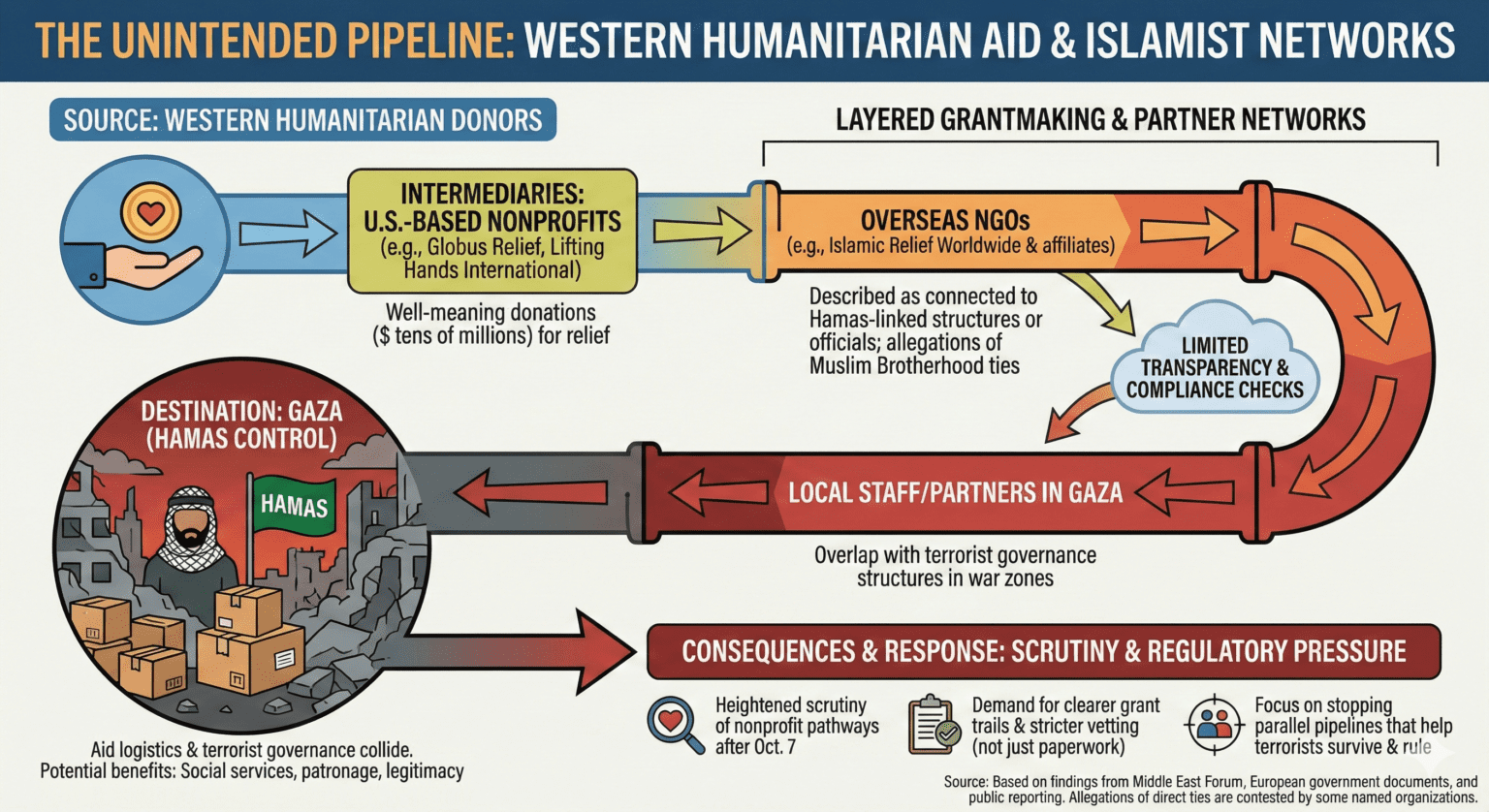
According to the report, Globus Relief transferred at least $119 million and Lifting Hands nearly $20 million to about ten such groups over several years.
One focal point is Islamic Relief Worldwide and affiliated entities, including activity tied to Gaza.
The report argues that in the chaos of war, layered grantmaking and on-the-ground partnerships can become a liability, especially when local staff or partner networks overlap with terrorist governance structures.
Some of the report’s most pointed claims involve photos and public-facing events in Gaza that it says show proximity to Hamas figures—claims that are politically explosive and not always independently verifiable from open sources alone.
European government documents cited in the broader debate highlight why the issue keeps resurfacing.
In Germany, a federal parliamentary document states that, according to the government, Islamic Relief Germany and Islamic Relief Worldwide have “significant personal connections” to the Muslim Brotherhood or related organizations.
In the Netherlands, a parliamentary Q&A records that the government decided not to grant a subsidy to Islamic Relief Worldwide after allegations of possible ties to the Muslim Brotherhood surfaced and it sought information from other donors.
That context matters because Hamas has long been assessed to benefit from “charitable” ecosystems that double as political infrastructure—social services, patronage, recruitment, and legitimacy.
The U.S. has previously targeted this model directly: the U.S. Department of the Treasury designated the “Union of Good” as a Hamas-support network, describing it as a group of charities that served as a fundraising facilitator for Hamas.
To be clear, none of this automatically proves that every dollar sent by Western donors becomes terrorist money—or that donors intended anything of the sort.
The more realistic and troubling scenario is structural: well-meaning donations move through intermediaries, compliance checks lean on paperwork and local “partners,” and then war-zone realities collide with governance by a terrorist organization.
When transparency is limited—especially with religious or quasi-religious aid frameworks—the public often learns details only when watchdogs start connecting dots across filings and foreign reporting.
There is also a response side that readers should see.
Islamic Relief has publicly rejected allegations of political ties, saying it is a purely humanitarian organization and denying links to the Muslim Brotherhood.
Media outlets reported that the charities named in the investigation did not immediately respond to requests for comment in the reporting referenced.
Zooming out, this story lands in a moment of heightened scrutiny of nonprofit pathways into Gaza after the Oct. 7 massacre and the war that followed—when Hamas’s control of territory, distribution, and “civil” institutions makes clean separation between aid logistics and terror governance exceptionally difficult.
For Israel and its allies, the demand isn’t to block humanitarian relief; it’s to stop the parallel pipeline that helps terrorists survive, rearm, and rule.
The next phase is likely reputational and regulatory.
If the allegations hold up under deeper auditing, donors will face pressure to publish clearer grant trails, tighten counterparty vetting, and stop treating “trusted partner” status as a substitute for hard compliance—especially when the destination is territory controlled by a terrorist organization.
Mormon-affiliated US charities sent tens of millions to NGOs linked to Hamas, says watchdog appeared first on World Israel News.